Two different methods for underpinning historical buildings in Stockholm and Gothenburg
Underpinning was needed to prevent excessive settlement of historical buildings in Stockholm and Gothenburg. In Pyramiden, Stockholm, steel core piles were replaced by RD piles with threaded splicing. In Högvakten, Gothenburg, RR piles were used with two different techniques. Foundation contractor was Betongsprutnings AB BESAB in both underpinning cases.
Costs savings due to the replacement of steel core piles to RD piles and the use of high strength steel in Kv Pyramiden in Stockholm
Ten buildings established between 1898 and 1914 needed underpinning to prevent excessive settlement. End customer was Svenska Bostäder. Skanska Sverige AB was general contractor and Betongsprutnings AB BESAB was foundation contractor. Each building was underpinned using 50 - 300 drilled RD piles with threaded splicing and each pile needed to be between 20 m and 25 m long to reach the bedrock. Drilling of piles was done with water powered drilling.
Through the development of a custom made drop hammer, BESAB’s own design, the bearing capacity of the drilled RD piles could be measured even in the tightest of work spaces. This made it possible for BESAB, in agreement with the customer, to switch from steel core piles to RD piles. This change of piles led to savings between 10% - 20% for the project. The use of SSAB’s high strength steel piles in S550 grade contributed a lot to the savings.
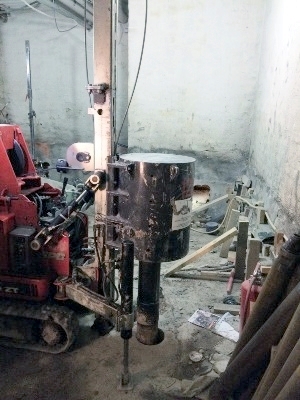
Figure 1. Bearing capacity measured with PDA by using custom made drop hammer even in the tightest of work spaces.
SSAB’s delivery included RD170/10, RD170/12.5, and RDs170/10 piles with threaded splices. Length of pile elements varied between 1 - 1.5 m. Delivery was in total 1 159 m, 1 136 pile elements.
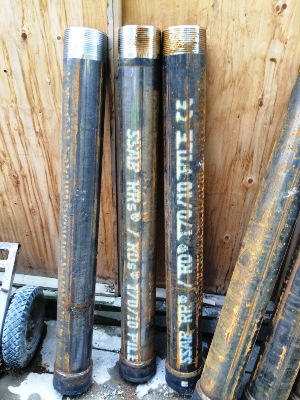
Figure 2. SSAB’s delivery included threaded RD piles and high strength steel RDs piles.
RR piling in Kv Högvakten, Gothenburg
Four of Gothenburg’s oldest buildings in the city centre needed underpinning due to excessive settlement. Higab, a real estate company owned by the City of Gothenburg, ordered the underpinning from foundation contractor Betongsprutnings AB BESAB. Steel piles were delivered by SSAB. The underpinning used two different techniques. One technique was to core drill through the dry rubble, then drive RR piles on each side of the dry rubble and place a bearing beam on top of the driven RR piles which carries the weight of the building. All of the steel above ground was grouted for protection against corrosion. The other technique used was zig-zag piling. Holes were core drilled with a slight incline through the wall and stone foundation. Then RR piles were driven through the holes to the hard bearing layer and cut from the bottom level of the foundation. Finally the holes in foundation were filled with concrete.
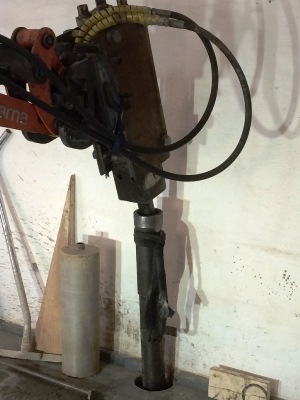
Figure 3. Driving of RR pile.
SSAB’s delivery consisted of RR piles, RR90 and RR115/6.3, including rock shoes and bearing plates. Delivery was in total 1 258 piles, 36 000 m. Length of pile elements varied between 1-3 meters.
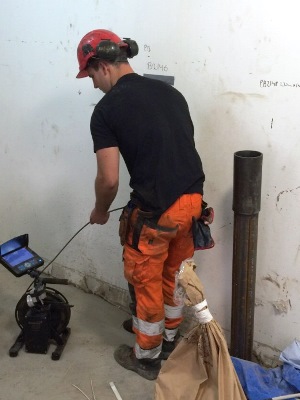
Figure 4. Control of splices.
Attachments
Category and tags